book review · Echopraxia
Echopraxia
2026-04-17 · 3 min read
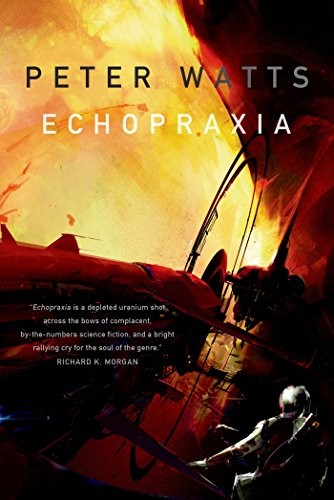
I read Blindsight first, like most people apparently do, and came into this expecting a direct sequel and got something stranger, a parallel story in the same collapsing-human-relevance future, with a different narrator and a plot that swerves hard into territory I did not see coming. Zombies, vampires, a monastery of genetically engineered hive-mind monks, and underneath all of it Watts is still asking the same brutal question that made Blindsight land, whether consciousness is actually useful for anything or just an expensive accident evolution hasn’t gotten around to deleting yet.
The prose is the thing that carries you through when the plot gets murky, and it does get murky, dense and technical and backed by actual scientific citations in an appendix, the kind of book where you can feel Watts starting from real neuroscience papers and building a story machine around the implications. Bruks, the biologist narrator, is doing real work here that the first book didn’t quite have, a human viewpoint character surrounded by post-humans and reavers who barely register him as worth talking to, and that outsider perspective is what a few readers have pointed out was actually missing from Blindsight, where everyone already understood the world they were losing.
Where it stumbles for me is the back half’s turn toward faith and religion as a subject, Watts spends real space on whether God can exist inside a coldly rational universe, and while the ideas are dense and genuinely provoking, it reads more like an essay wedged into the narrative than a story that earns its own digressions. A few reviewers have called it tedious in a way Blindsight never was, and I think that’s fair even though I don’t think it sinks the book, it’s more that the density starts working against momentum in a way the first book’s tighter focus avoided. This is not a book to start the series with, and it’s not an easy read even once you have Blindsight behind you. But nobody else in the field is writing anything that hits like this, technical, bleak, and genuinely trying to think past the edge of what consciousness is actually for.